

Case Study
Case Study
Discover

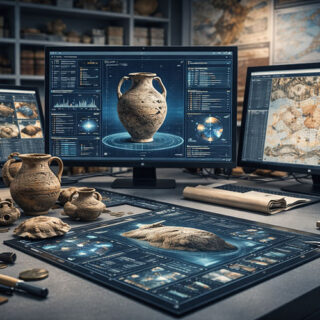
AI-Assisted 3D Analysis of Dacian Koson Coins
This case study illustrates how advanced digital technologies, including artificial intelligence and 3D digitization, can significantly improve the analysis and documentation of cultural heritage artifacts. The study focuses on the automatic processing and analysis of Dacian Koson-type coins, combining image processing algorithms with high-precision 3D scanning techniques.
Case Study: Digital Analysis of Dacian Koson Coins
A research team from the CulTech consortium, consisting of specialists from the Technical University of Cluj-Napoca (UTCN) and the “Vasile Pârvan” Institute of Archaeology and Art History (ARFC), conducted a series of studies aimed at improving the digital analysis of ancient coins using advanced computational methods.
The study focused on the automatic processing of 2D images of Dacian Koson-type coins using artificial intelligence algorithms. Based on a representative dataset of more than 600 coins, the researchers optimized a pattern recognition algorithm using cross-correlation techniques. This approach made it possible to identify the dies used in coin striking and analyze the production process of these ancient artifacts.
However, the research team observed that the use of 2D digitization alone leads to a significant loss of information. Koson coins are typically hoard coins that did not circulate in regular trade, meaning that their physical characteristics contain valuable information about their production process. In this context, 3D digitization offers substantial advantages.
Through 3D scanning, researchers can determine additional parameters that cannot be accurately captured using traditional imaging methods. One important characteristic is the volume of the coin, which traditionally was measured using the water displacement method. This manual technique is often imprecise, whereas 3D models allow highly accurate volume measurements.
The volume measurement is essential for calculating the density of the coin, which helps researchers determine differences between theoretical and actual density values. Such differences may indicate manufacturing techniques such as plating, for example when a copper core is covered with a layer of silver.
For the purposes of the CulTech project, the team will use a high-precision optical scanning system capable of digitizing glossy and reflective surfaces, such as gold coins. The resulting 3D models will then be analyzed using computational methods including best-fit alignment and deviation analysis to identify subtle differences between coins.
The generated 3D models provide flexible visualization capabilities, allowing coins to be examined from any angle and at any scale. This enables researchers to observe important structural characteristics, such as the relative orientation of the obverse and reverse axes, which are often not aligned in ancient and medieval coinage.
Compared to traditional photographs, 3D models provide a far more detailed representation of surface features, enabling both manual examination and automated computational analysis. Combined with high-resolution texture data, these models can also produce realistic visual representations suitable for research, education, and digital publication.
Another major advantage of 3D digitization is the ability to perform precise measurements directly on the digital model, particularly volume measurements that are highly relevant for numismatic and cultural heritage studies.
Ultimately, the results of this research contribute to the identification, documentation, and protection of numismatic artifacts, supporting the conservation and long-term preservation of cultural heritage despite challenges such as the small size and highly reflective surfaces of coins.